A decline in tropical deforestation in 2025… but not yet a turning point
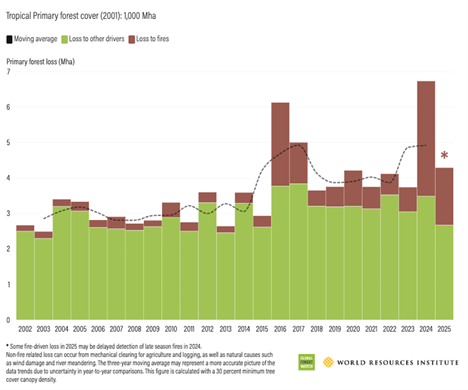
In 2025, the planet lost nearly 4.3 million hectares of tropical primary forests. This is equivalent to the size of Denmark, or more than eleven football fields destroyed every minute.
This figure represents a 36% decrease compared to 2024, a year marked by exceptional wildfires in several regions of the world.
However, this improvement must be put into strong perspective: forest loss remains 46% higher than it was ten years ago.
According to Global Forest Watch, current deforestation levels are still around 70% above the trajectory needed to meet the commitments made at the COP26 to halt and reverse deforestation by 2030.
This situation is particularly concerning, as tropical primary forests play an irreplaceable role in the global climate balance.
Why tropical primary forests are essential
Tropical primary forests perform essential functions:
- carbon storage;
- regulation of water cycles;
- maintenance of rainfall patterns;
- soil protection;
- biodiversity conservation;
- support for the livelihoods of millions of people.
Scientists consider these forests essential ecosystems in the face of climate change.
Yet between 2002 and 2025, the world lost around 87 million hectares of humid tropical primary forests. Over the same period, global tree cover declined by 540 million hectares (GFW).
Agriculture, mining, wildfires: the main drivers of deforestation
In 2025, agricultural expansion remains the main driver of tropical forest destruction. The conversion of forest land for soybean cultivation, cattle ranching, palm oil, and cocoa production continues to place considerable pressure on forest ecosystems, particularly in the world’s major tropical forest basins.
In addition to this agricultural pressure, mining activities also contribute to accelerating deforestation in several regions of the world, particularly for the extraction of gold and nickel.
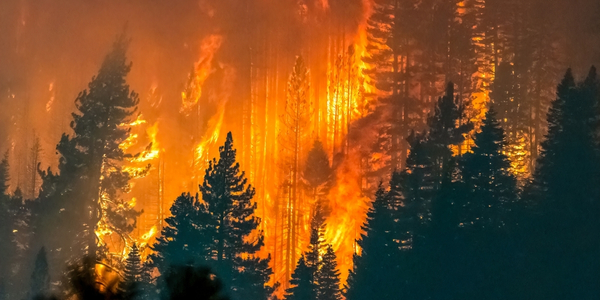
At the same time, wildfires now play an increasingly significant role in global forest loss. In 2025, they alone account for 42% of global tree cover loss.
Brazil shows that public policies can work
Much of the improvement observed in 2025 comes from Brazil, which is home to the largest tropical rainforest on the planet.
The country reduced its primary forest loss by 42% compared to 2024, reaching its lowest level of non-fire-related forest loss ever recorded.
This decline is largely linked to strengthened environmental policies since the return to power of President Luiz Inácio Lula da Silva. The Brazilian government has notably reinforced environmental enforcement, relaunched anti-deforestation plans, and increased penalties for environmental violations.
These results show that strong political will can quickly produce tangible effects in forest conservation. However, threats persist: soybean expansion and cattle ranching remain the main drivers of deforestation in Brazil, and some regulatory rollbacks still weaken progress.
Planète Urgence will soon launch a pilot project in Brazil to contribute to the protection and restoration of forest ecosystems alongside local stakeholders.
Other countries are also showing encouraging trends. In Colombia, primary forest loss declined by 17% in 2025 thanks to stronger forest governance, better recognition of Indigenous territories, and increased efforts to monitor supply chains.
Indonesia, Peru, Madagascar: contrasting but concerning situations
INDONESIA
In Indonesia, primary forest loss increased by 14% between 2024 and 2025, although levels remain well below the peaks observed in the mid-2010s.
This relative stability is partly explained by several protection measures: a moratorium on new concessions in primary forests and peatlands, improved fire prevention, and private-sector commitments in the palm oil supply chain.
However, agricultural and mining expansion continues to place significant pressure on forest ecosystems, particularly through the development of agricultural projects and nickel extraction.
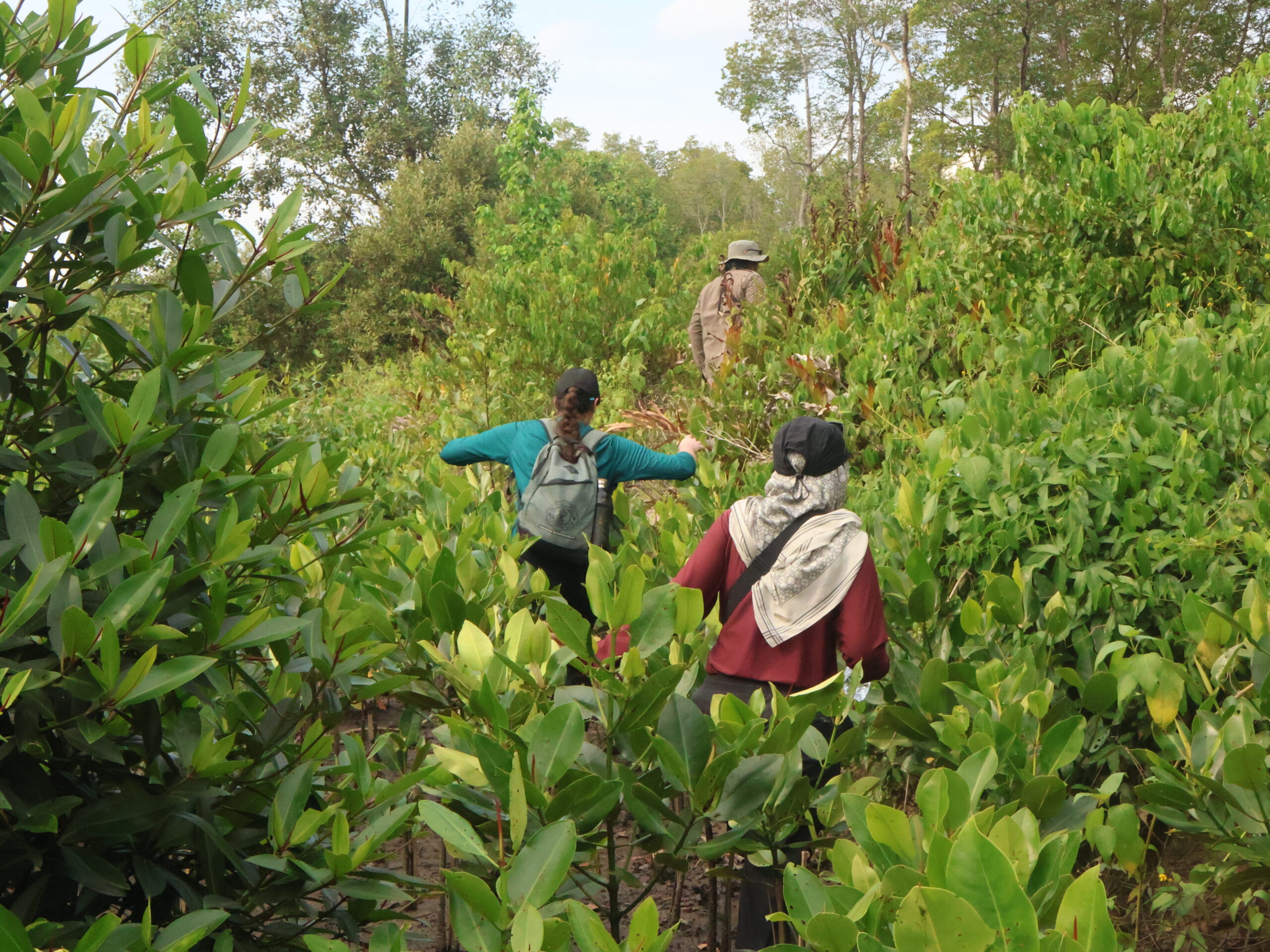
Planète Urgence has been working for many years in Indonesia to protect mangroves, restore forest ecosystems, and support local communities in developing sustainable economic activities that are compatible with the preservation of natural resources.
MADAGASCAR
In Madagascar, the situation remains particularly alarming. The country lost nearly 2% of its primary forest in a single year, while the remaining forest areas are already highly fragmented.
In several regions, deforestation is strongly linked to local needs for energy and agricultural land, in a context of poverty and economic vulnerability.
This gradual disappearance of forests directly threatens the island’s exceptional biodiversity as well as the populations that depend on forest resources.
Planète Urgence develops landscape restoration, agroforestry, and awareness-raising projects in Madagascar in order to reduce pressure on natural forests.
PERU
In Peru, primary forest loss declined by 8% in 2025 compared to the previous year. Despite this decrease, the country remains among the ten most affected in the world by tropical deforestation.
The expansion of cocoa and palm oil production, as well as gold mining, continues to drive the destruction of Amazonian forests.
In the Madre de Dios region, gold mining has become one of the main drivers of forest loss.
Planète Urgence works in Peru through forest restoration projects, environmental awareness initiatives, and support for local communities in adopting more sustainable practices.
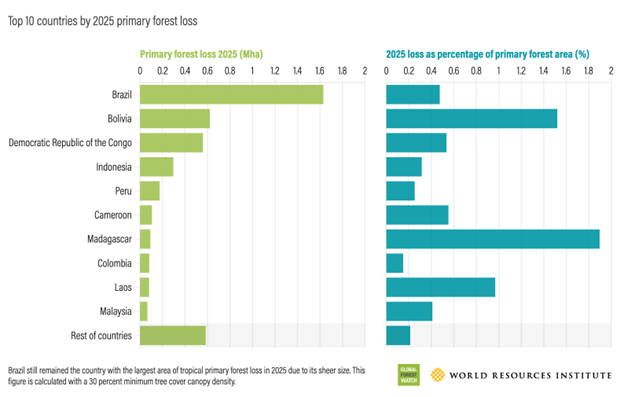
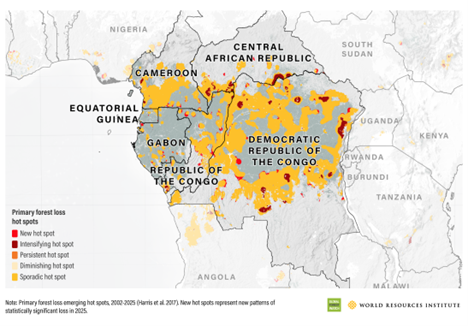
The Democratic Republic of the Congo recorded the third-highest global loss of tropical primary forest in 2025. In this region, deforestation is often linked to subsistence agriculture, charcoal production, and a lack of economic alternatives.
Cameroon also experienced record levels of primary forest loss in 2025, the highest ever recorded. This increase is notably driven by the expansion of cocoa cultivation as well as population displacement caused by armed conflicts in certain regions.
The Congo Basin is nonetheless the largest remaining tropical carbon sink in the world after the Amazon.
Its degradation not only weakens biodiversity and local communities, but also the planet’s ability to absorb a portion of greenhouse gas emissions.
Forests increasingly vulnerable to climate change
Climate change is no longer only a consequence of deforestation: it is also becoming a driver of it. Droughts, heatwaves, and more frequent wildfires are increasing the vulnerability of forest ecosystems.
Scientists are also warning about the risk of tipping points. In some regions, such as the Amazon, the combination of deforestation and climate disruption could gradually transform tropical rainforest into savannah-like landscapes.
Such a shift would have major consequences for the global climate, biodiversity, and human populations.
Forests: a climate, social, and human issue
The destruction of forests is not only an environmental crisis. It also threatens:
- food security;
- access to water;
- local economies;
- the livelihoods of millions of people;
- traditional cultures and knowledge.
In many tropical regions, local communities depend directly on forests for their survival: an estimated 1.6 billion people worldwide rely directly or indirectly on forests for their livelihoods (World Bank).
Protecting forests therefore means supporting development models that can meet human needs while limiting pressure on natural resources.
How Planète Urgence acts to protect forests
Faced with the scale of deforestation, tree planting alone is not enough. At Planète Urgence, we advocate a holistic approach to forest conservation based on forest landscape restoration and sustainable local development. Our FO.RE.T strategy (Forests, Resilience and Territories) is grounded in a strong belief: forests and the communities that depend on them are inseparable.
We act simultaneously on the causes and consequences of deforestation through three main levers:
Restoring forest ecosytems
We support reforestation and ecological restoration projects adapted to local contexts: development of agroforestry systems, mangrove restoration, planting of native species, and restoration of degraded landscapes.
The goal is not only to plant trees, but to rebuild resilient and functional ecosystems.
Supporting sustainable economic alternatives
Strengthening the capacities of local stakeholders
Act now to protect forests
The 2025 data show that a slowdown in deforestation is possible. However, they also highlight that progress remains insufficient in the face of the climate emergency.
Protecting forests is one of the most powerful levers for tackling climate change, preserving biodiversity, and supporting the most vulnerable populations.
Support our forest protection actions
Vous aimerez aussi …
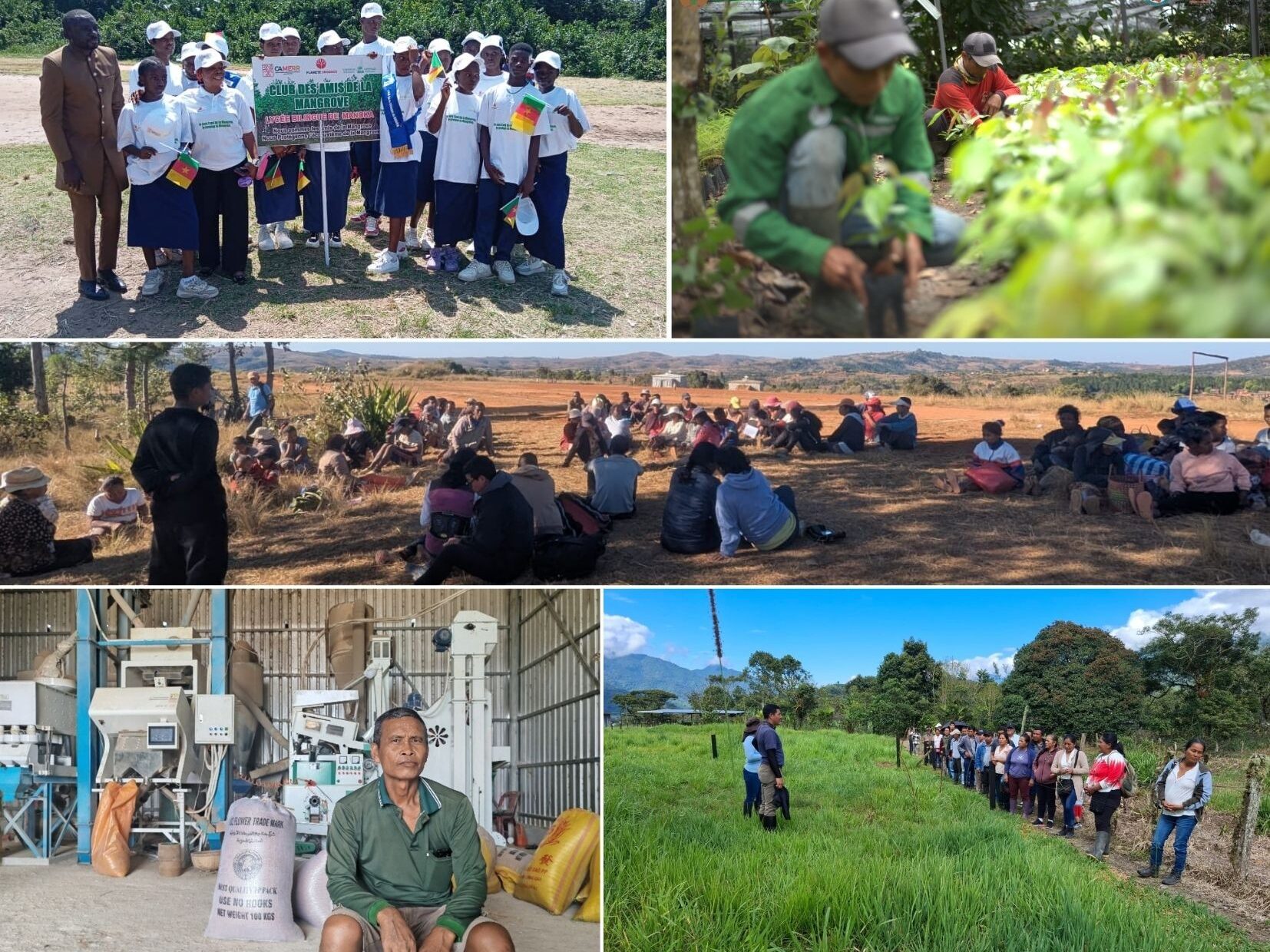
Local solutions on the ground to protect forests and biodiversity
Discover the latest field initiatives aimed at protecting forests, biodiversity and local communities.
2025 activity report: a year of impact for forests and communities
Planète Urgence has published its 2025 activity report, a document that highlights a year of concrete actions in support of…