
Combating deforestation
and climate change
a closely linked commitment
Combating deforestation involves preserving or restoring forests in order to protect biodiversity and reduce greenhouse gas emissions. It is a key lever in the fight against climate change, as the two issues are inextricably linked.
Deforestation is responsible for around 11% of global greenhouse gas emissions (IPCC). Every year, millions of hectares disappear, leading to the release of stored carbon, changes to the water cycle and a loss of biodiversity that weakens the resilience of our ecosystems. In the face of the climate emergency, protecting and restoring tropical forests has become a collective imperative.
Forests: pillars of the global climate
Role in carbon storage
Forests are powerful carbon sinks: they capture and store CO₂ from the atmosphere.
- Tropical forests absorb up to 1.8 gigatonnes of CO₂ per year (roughly equivalent to Russia’s annual emissions in 2017).
- On their own, they store seven times more carbon than humanity emits each year.
Destroying a forest therefore releases, in a matter of days, the carbon accumulated over centuries.
Impact on the water cycle and rainfall
Forests regulate humidity and rainfall through evapotranspiration. In the Amazon, for example, this phenomenon creates ‘flying rivers’: vast masses of moist air carried by the winds that influence rainfall patterns as far away as Argentina. When the forest disappears, these flows are interrupted, leading to droughts, reduced agricultural yields and an increased risk of wildfires.
Preserving biodiversity for climate resilience
Nearly 80% of terrestrial biodiversity is found in forests. This genetic diversity is a major asset in the face of climate change: the richer an ecosystem is, the more likely it is to adapt to changes. Preserving this biodiversity means strengthening the planet’s ability to absorb climate shocks.
How does forest destruction accelerate climate change?
Deforestation causes:
- massive CO₂ emissions during logging and slash-and-burn practices;
- the loss of ecosystem services (water regulation, soil fertility, pollination);
- a snowball effect:
- deforestation
- increased drought
- more frequent fires
- additional carbon emissions
Key measures to combat deforestation and climate change
Protection of existing forests
The most urgent priority is to preserve forests that remain intact, as a destroyed primary forest cannot be recreated exactly as it was. The establishment of protected areas, supported by strong local governance, is a cornerstone of environmental conservation.
But protecting a forest is not simply a matter of drawing boundaries: we must also support neighbouring communities so that they have a stake in conserving it. By involving communities in management, securing their land rights and developing economic alternatives, protection becomes socially acceptable and environmentally sustainable.
Restoration of degraded ecosystems
Where the forest has already receded, ecological restoration is essential. It is not just a matter of planting trees, but of recreating a living landscape, with local species adapted to the climate and soil.
This approach, known as Forest Landscape Restoration (FLR), enables the restoration of entire ecological functions: carbon sequestration, water regulation, and habitats for biodiversity.
In certain regions, such as Madagascar or Indonesia, this restoration takes the form of mangrove replanting, which protects coastlines from erosion whilst storing significant amounts of carbon.
Supporting sustainable livelihoods
Pressure on forests often stems from the poverty of local communities, who depend on logging or shifting cultivation to survive. Offering alternative and viable livelihoods is therefore key.
Agroforestry, for example, combines trees with food crops, improving soil fertility whilst generating income. Other sectors, such as wood energy, help to diversify resources. It is by offering environmentally friendly economic opportunities that we can sustainably reduce deforestation
International mobilisation and partnerships
Deforestation is a global phenomenon. Responses must therefore transcend borders. France has adopted a National Strategy to Combat Imported Deforestation (SNDI), which aims to reduce the environmental footprint of its imports by 2030.
At the global level, scientific and citizen-led platforms such as CIFOR-ICRAF and Global Forest Watch provide valuable data to guide public policy. Finally, international alliances, such as the Alliance for the Preservation of Tropical Forests, bring together producer and consumer countries to build more responsible supply chains.
Raising awareness and mobilising citizens
Finally, no strategy to combat deforestation and climate change is complete without awareness-raising initiatives. Informing local communities, training teachers and engaging younger generations is essential to creating a new forest culture.
But raising awareness also concerns consumers and businesses: everyone, through their consumption choices and partnerships, directly influences the survival of tropical forests.
How can everyone get involved?
A local and integrated approach
Planète Urgence carries out its work in areas where three priorities converge: proven or imminent deforestation, exceptional biodiversity, and communities that are highly vulnerable to climate change. This locally-rooted approach enables us to address both environmental and social emergencies simultaneously.
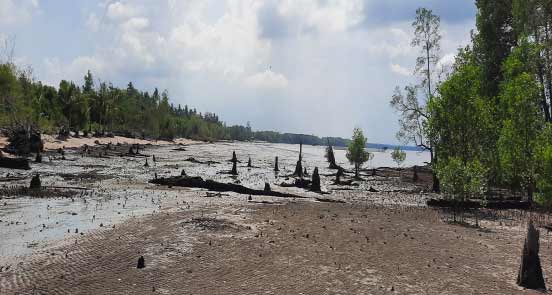
In practical terms, our projects are based on a balanced combination of three
dimensions:
-
Preserving threatened forests and ecosystems
by strengthening existing conservation measures;
-
Restoring degraded landscapes
through reforestation, soil protection and natural regeneration programmes;
-
Supporting local development
by promoting sustainable economic activities (agroforestry, responsible supply chains, alternatives to the overexploitation of resources).
Each project is designed in collaboration with local stakeholders to ensure its relevance and sustainability. This approach is based on the principles of non-substitution (not replacing existing stakeholders), non-competition (not undermining the local economy) and sustainability (promoting the autonomy of beneficiaries).
Examples of initiatives
Competition for arable land or mineral resources leads to population displacement and fuels conflicts linked to land grabbing.
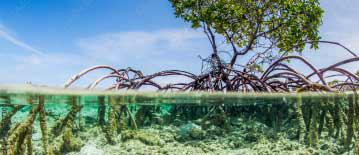
MANGROVE RESTORATION
In Cameroon, Madagascar and Indonesia, our teams work with local communities to replant and protect these coastal ecosystems. Mangroves absorb up to five times more carbon than a terrestrial forest and act as a natural barrier against storms and erosion, whilst supporting local fishing activities.

AGROFORESTRY
In Benin and Madagascar, we support farmers in establishing tree-shaded crops (cocoa, vanilla, food crops). In Peru, the CUISCAF project supports coffee cooperatives in developing shade-grown coffee, which improves product quality whilst preserving Andean forests.
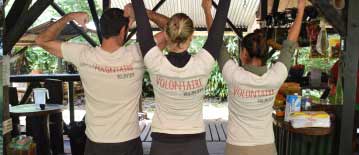
ENVIRONMENTAL AWARENESS
Through the Planète Éducation programme, we work in schools and local communities to impart the knowledge needed to protect the environment.
Every year, several thousand pupils take part in workshops on biodiversity, sustainable resource management and adaptation to climate change
Planète Urgence’s strategy in response to these challenges
Businesses and environmental sponsorship
Businesses can commit to an environmental sponsorship initiative. This support can take several forms: financial sponsorship, which directly contributes to the funding of forest conservation and restoration projects, or a Solidarity Leave®, which enables their employees to go on a volunteering mission with local partners to put their skills to work on projects with a social and environmental impact.
Supporting Planète Urgence enables businesses to strengthen their CSR policy and give concrete meaning to their climate commitments.
Citizens and individual commitment
On an individual level, everyone can also contribute to the environmental cause. Adopting more responsible consumption habits is a first step: limiting the purchase of products linked to deforestation (uncertified palm oil, imported soya, beef from deforested areas) helps reduce pressure on tropical forests.
But the action doesn’t stop there. By choosing to support an organisation such as Planète Urgence through one-off or regular donations, you ensure the continuity of awareness-raising, restoration and local development initiatives carried out in the most vulnerable countries.

For those who wish to take things a step further, it is also possible to get involved as a volunteer through short-term placements such as the Congé Solidaire®, long-term placements, or even remote volunteering.