Description
Objectifs
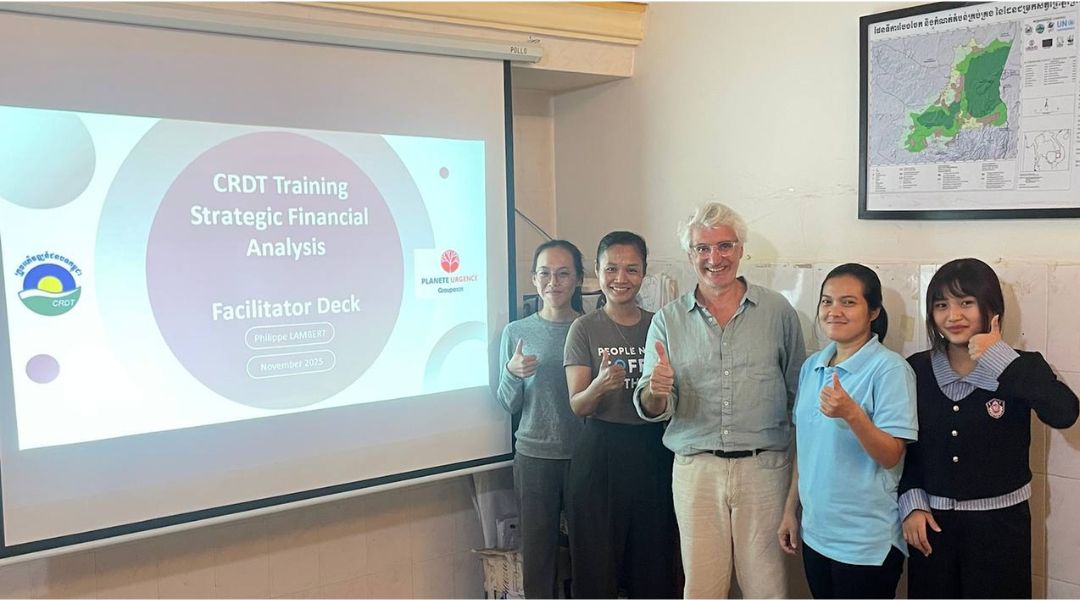
CRDT has recently reorganised its team and now operates from a much clearer internal structure. However, the organisation needs external strategic coaching to review the current positioning and performance of Le Tonlé and CRDT Tours, strengthen their revenue models, and develop actionable competitive strategies adapted to the Cambodian eco-tourism market.
PU volunteers are called upon because CRDT lacks in-house expertise in social enterprise strategy.
Intervention attendue du volontaire
1. Strategic diagnostic- Review the current situation of Le Tonlé and CRDT Tours: revenue streams, operating costs, customer segments, market positioning, competitive landscape (other guesthouses, eco-tourism operators in Kratie).
2. Business model review -Assess whether the current revenue model is viable and sustainable. Identify gaps, inefficiencies and opportunities.
3. Competitive strategy – Help the team define a clear value proposition and differentiation strategy for each enterprise (e.g. eco-tourism packages, community-based tourism, sustainable accommodation labels, international vs. domestic markets).
4. Operational KPIs – Co-design a simple monitoring dashboard for each enterprise (occupancy rate, revenue per customer, monthly P&L tracking).
5. Action plan – Deliver a written 12-month action plan per enterprise, with prioritised recommendations.
Working method: participative and practical — work directly with the team on real data, not theoretical frameworks. All sessions must be adapted to the team’s language level (English, intermediate).
Remarque(s)
– Phnom Penh is the capital city of Cambodia so it’s a very urban environment. Many local & western restaurants and supermarkets.
Many sites to visit during you days off (Royal Palace, National Museum, Sunset Rivercruise on the Mekong, Wat Phnom Temple, Tuol Sleng genocide museum, Central Market, Russian Market, …)
– Kratie is a small town on the Mekong River (4–5 hours from Phnom Penh by bus). It offers basic touristic infrastructure, eco-tourism activities with local communities, and the possibility to observe the rare Irrawaddy dolphins. Malaria and dengue are present — preventive medication recommended. Avoid walking alone at night.
Le Tonlé guesthouse and restaurant is CRDT’s own social enterprise — the volunteer will be staying and working in the organisation’s actual operational context, which is a unique advantage.
Location: CRDT’s office, Phnom Penh and Kratie town (Le Tonlé).
Indicative agenda:
Day 1: Arrival Phnom Penh.
Day 2: Welcome meeting, organisational overview, review of existing documents.
Day 3–4: Strategic diagnostic of Le Tonlé (revenue review, market positioning, SWOT).
Day 5–6: Strategic diagnostic of CRDT Tours (value chain, pricing, market analysis).
Day 7-8: Day off the bus to Kratie.
Day 9–10: Co-design of business model canvas and KPI dashboards with the team. Training session.
Day 11–12: Development of 12-month action plans (one per enterprise). Training session.
Day 13: Writing recommendations report and mission debrief with the full team. Return to Phnom Penh (bus).
Day 14: Departure.
Type de bénéficiaires
3–4 members will work directly on the training and participate fully in it. Others will mostly take part, but not in its entirety, as they are not directly responsible for these tasks; for example, the executive director or members of the administrative staff.
Profil des bénéficiaires
Nombre de volontaires requis
1 volontaires
Motivation attendue
Business development, social enterprise, strategy management
Strong command of English (written and spoken) is required — all sessions are in English.
As the training must be very interactive, the volunteer will also have to adopt a practical approach.
Le partenaire
Notre partenaire local
Cambodian Rural Development Team (CRDT)
Historique
The Cambodian Rural Development Team (CRDT) was created in 2001 by four Cambodian students. They came from poor rural backgrounds and were the first generation to go to university. Belonging to the first educated generation after the Khmer Rouge period, the 4 founders of the Cambodian Rural Development Team (CRDT) were disadvantaged rural children. Access to education was an uphill struggle. Hard work and extraordinary circumstances saw CRDT founders meeting at university, and being in the minority coming from underprivileged backgrounds, they banded together as a team. They developed a shared vision for the future of Cambodia – ‘one free from environmental degradation and poverty’ as they found that in Cambodia few rural people survive entirely on what they produce from their own land. They supplement their livelihoods by hunting, fishing or gathering forest products. But overfishing and deforestation are threatening both this way of living and ecosystems. The Mekong River Dolphin and many other critically endangered species are on the verge of extinction due to destructive natural resource usage. CRDT founding members come from rural backgrounds so it’s no stretch of the imagination to learn that they care about rural communities. They experienced poverty first hand in their youth, and saw how closely linked poverty is to natural resources. If livelihoods are tied to environmental issues, a population exploding after years of atrocities means more people sharing Cambodia’s natural bounty. This free-for-all of natural resource exploitation cannot last. CRDT has high technical expertise and extensive experience in environmentally appropriate agriculture development, increasing food security, supporting market linkages and income generation, natural resource management, non-timber forest products, water and sanitation, renewable energy technologies, eco-tourism and community empowerment. Currently, the organisation focuses on three of Cambodia’s north-eastern provinces: namely Kratie, Steung Treng (along the Mekong) and Mondulkiri. The projects’ target communities are selected in conjunction with conservation partners, World Wide Fund for Nature (WWF) and Wildlife Conservation Society (WCS), to be areas of particular interest for conservation where biodiversity is threatened by livelihood activities and exploitation of natural resources. CRDT supports approximately 6,000 families in rural Northeastern Cambodia in those 3 provinces. Most of these families are from ethnic minorities and are subsistence farmers living in protected areas. CRDT close partners WWF and Wildlife Conservation Society (WCS) provide technical support such as training on conservation, monitoring and evaluation. CRDT also has partnerships with Délégation Catholique pour la Coopération (DCC) and Volunteer Services Overseas (VSO), which provide long-term volunteers supporting the work of the organisation. CRDT employs 27 people among which 6 advisers, foreign and local. CRDT current programs focus on: – Food Security: supporting livestock, aquaculture and vegetable production, and increasing the yield of rice crops in order to ensure communities have access to a protein-rich and varied diet, and to diversify food sources to equip villagers to adapt to a changing climate. – Income Generation: enabling farmers to identify value chains and directly access markets to generate income raises standards of living. Diversifying income through the creation of small businesses such as community-based tourism, which brings a range of community benefits. – Water & Sanitation: supporting families to build their own rainwater collectors next to their homes, which is a relatively clean, free and close source of water to be used for household consumption. CRDT also supports agricultural beneficiaries to set up small irrigation aids such as river hand pumps, which brings river water closer to the fields and enables farmers to grow off-season vegetables and sell them at profit. – Renewable Energy: CRDT beneficiaries are highly dependent on firewood and exploitative natural resource management practices for their daily energy needs, despite many communities living in protected biodiversity areas. CRDT therefore tries to focus on providing for these needs sustainably, by developing a number of rural renewable energy technologies including biogas, micro-hydro and solar. – Environmental Education and Waste Management: To CRDT, this means demonstrating how livelihoods link to sustainability, forming values to enable communities to understand their environment, reduce exploitation and manage their natural resources responsibly, at a time of climatic uncertainty. – CRDTours: specializes in responsible tourism in the Mekong provinces of Kratie and Stung Treng. All tours directly support local communities and environmental conservation through donations to CRDT. – Conversations with Foreigners: Conversations With Foreigners (CWF) is an English-language centre set up to provide sustainable funding for CRDT’s work. – Le Tonlé: Le Tonlé Tourism Training Center is a not-for-profit training guest house providing vocational training to disadvantaged youth from Cambodia’s Northeastern provinces of Kratie, Stung Treng, Ratanakiri, and Mondulkiri.
Informations pratiques
Accueil et transfert
Return journey: bus from Kratie to Phnom Penh on the last working day (Friday).
Aéroport d’arrivée
Hébergement
10-15mn away from the office in tuktuk.
In Kratie: Le Tonlé guesthouse (individual private room, key-lock, private bathroom, Wi-Fi). Meals at the guesthouse restaurant or nearby. CRDT will arrange accommodations.
Matériel disponible sur place
Code mission : CB1KC11
 Partenaire :
Cambodian Rural Development Team (CRDT)
 Localisation :
Cambodge, Asie, Phnom Penh & Kratie
 Langues :
Anglais
 Type d’intervention :
Formation pour adultes
 Compétences :
Commerce
 Dispositif(s) possible(s) :
Congé Solidaire, Mission Solidaire
 Durée :
2 semaines
 Mission disponible toute l’année